The best time to visit Lofoten
Lofoten has two seasons that hardly resemble each other. In winter the islands get a few hours of light and a chance of aurora at night; in summer the sun does not set for weeks. Here is what each month offers.
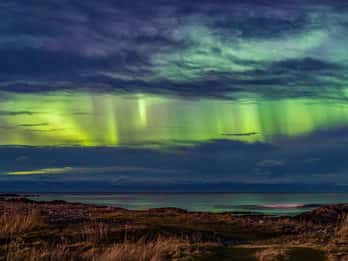
Northern lights by van from the tourist office
Van, bring own tripod · 4 hours
✓ Free cancellation
from €178
Book on GetYourGuide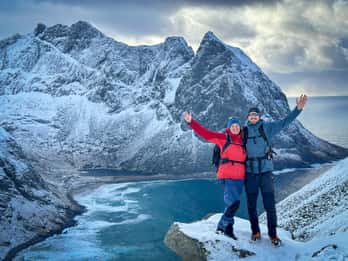
Winter hike to Ryten with hot meal
Mountain hike, max. 7 · 5-hour hike
✓ Free cancellation
from €292
Book on GetYourGuide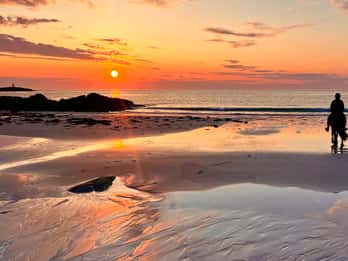
Midnight sun ride at Hov
Horse ride, beginners · 1.5 hours
✓ Free cancellation
from €155
Book on GetYourGuide
The Store norske leksikon notes that nowhere else on these latitudes has a winter as mild as Lofoten's. The coast keeps the islands near freezing from December to March and fairly cool in summer, so the temperature changes less over the year than you might think. The light is what really changes. On 1 December the sun is up in Svolvær for about two hours. On 1 June it does not set at all.
Lofoten month by month
Temperatures are the 1991–2020 averages for Svolvær airport, rain the averages for Leknes airport, about 70 km further west by road. Daylight is the time from sunrise to sunset in Svolvær on the first of the month, calculated by the US Naval Observatory for the 2026/27 season.
| Month | Average at Svolvær | Rain at Leknes | Daylight on the 1st | Worth knowing |
|---|---|---|---|---|
| January | 0.3 °C | 201 mm | Polar night | First sunrise in Svolvær on 6 January |
| February | −0.4 °C | 179 mm | 5 h 46 min | Skrei season under way, aurora nights |
| March | 0.3 °C | 167 mm | 9 h 44 min | Over nine hours of daylight, still dark at night |
| April | 2.7 °C | 86 mm | 13 h 50 min | Aurora season ends, fish on the drying racks |
| May | 6.6 °C | 71 mm | 18 h 05 min | Light nights; midnight sun from the last week |
| June | 10.1 °C | 43 mm | Midnight sun | Driest month, sun above the horizon all night |
| July | 13.3 °C | 40 mm | Midnight sun | Warmest month, busiest time on ferries |
| August | 12.7 °C | 55 mm | 19 h 50 min | Nights still light, Lofoten lamb from now on |
| September | 9.8 °C | 128 mm | 15 h 11 min | Dark evenings return, aurora season begins |
| October | 5.6 °C | 177 mm | 11 h 13 min | Berries and mushrooms, first lutefisk |
| November | 3.3 °C | 187 mm | 7 h 01 min | Short days, frequent rain |
| December | 1.5 °C | 274 mm | 2 h 09 min | Wettest month, polar night from 7 December |
Rain figures vary sharply across the islands. Near Svolvær, the Kongsmarka station averages roughly 2,350 mm a year, against about 1,600 mm at Leknes. Treat the column as a pattern: wet from September to March, much drier in early summer.
Winter, from December to March
Around Christmas the sun stays below the horizon. In Svolvær that lasts from 7 December 2026 to 5 January 2027, in Reine from 10 December to 2 January. Midday is never fully dark, though. On 21 December Svolvær gets civil twilight from 09:24 to 14:35. Our page on the polar night and the midnight sun explains what these hours look like.
Visit Lofoten gives the main season for the northern lights as September to April. You need darkness and a clear sky, and the aurora itself cannot be guaranteed. February and March combine dark nights with a useful amount of daylight for sightseeing, and the long-term average stays around freezing. It is not always mild: Svolvær airport recorded −10 °C on 17 January 2024.
Late winter is also fishing season. The Store norske leksikon dates the Lofotfisket, the seasonal catch of spawning cod called skrei, to February to April, with most fish arriving in the Vestfjord in February and March. Visit Lofoten describes the skrei season as running from January to April. Afterwards the cod hangs on wooden racks for two to four months until it has become stockfish.
Spring, April and May
The light returns quickly. By 1 April the sun is up for almost fourteen hours, by 1 May for eighteen, and the aurora season ends because the nights are too light. Some winter tours keep running into April: the guided snowshoe hike to Ryten above Kvalvika runs from October to April. The fish-drying racks are full in this period.
Summer, June to August
From late May the sun stays up around the clock. The US Naval Observatory puts the midnight sun in Svolvær from 26 May to 18 July 2027 and in Reine from 28 May to 17 July. Visit Lofoten recommends travelling between 28 May and 14 July. The astronomical dates assume a flat horizon, and in Lofoten the mountains can hide a low sun. That is why midnight sun tours drive to the north-facing coast at Eggum and Gimsøya.
June and July are the driest months, and July is the warmest with 13.3 °C on average at Svolvær. This is also when the islands are busiest. Many cruise ships call in summer, and Visit Lofoten advises reserving a place on the ferry at least the day before. Some tours only run now, such as the midnight sun ride at Hov on Gimsøya.

Autumn, September to November
From September the nights darken again and the aurora season opens. Visit Lofoten points out that Lofoten lamb can be on menus from August, that the ground is full of lingonberries and the woods hold chanterelles and boletus, and that the first lutefisk appears in October. The weather turns wetter in this period, and November is short on daylight. Ferry crossings from Bodø to Moskenes are less frequent in winter, so check the timetable if you travel late in the year.
Choosing your dates
For aurora with time to see the islands by day, pick February or March. For hiking, beaches and the midnight sun, pick June or the first half of July and book ferries and tours early. September suits travellers who want dark skies without winter roads. And if the skrei fishery and its drying racks interest you, aim for late winter and spring. For a day-by-day plan, see our Lofoten itineraries.
All tours side by side
Tours whose dates follow the light or the fish: aurora evenings from early autumn, the Ryten winter hike from October to April, a ride under the midnight sun and a fishing trip that targets skrei or mackerel depending on the month.
| Tour | Format | Duration | Age | Rating | From |
|---|---|---|---|---|---|
| Summer bus tour for cruise passengersLofoten LightsA local bus with an English-speaking guide meets cruise ships at Leknes (Gravdal) or Svolvær and runs to Reine and Å or to Haukland and Henningsvær, depending on the port. | Bus, cruise passengers onlyLocal guide, bus, port pickup | 6 hoursLeknes (Gravdal) or Svolvær cruise pier | – | 4.7 (209 reviews) | From €139Free cancellationBook on GetYourGuide |
| Traditional fishing on MS SymraXXLofotenOn the fishing vessel MS Symra you share one of ten fishing stations, learn to fillet on board and can take the catch home, with skrei or mackerel depending on the season. | Fishing vessel, shared stationsFishing kit, safety equipment, crew | 3 hoursSvolvær harbour | – | 4.5 (187 reviews) | From €105Free cancellationBook on GetYourGuide |
| Northern lights by van from the tourist officeLofoten Aktiv ASPickup at Svolvær tourist information and a climate-controlled van to viewing areas in Vågan, with tripods welcome; the tour runs from early autumn to mid-April. | Van, bring own tripodGuide, van transport | 4 hoursSvolvær tourist information | – | 4.5 (119 reviews) | From €178Free cancellationBook on GetYourGuide |
| Winter kayaking in Svolvær harbourXXLofotenAn instructor fits you with a dry suit at Svolvær harbour and leads a two-hour winter paddle in stable double kayaks, with stories about the town on the way. | Double kayak, dry suitKayak, dry suit, spray cover, life vest, guide | 2 hoursSvolvær harbour | Adults only | 4.9 (94 reviews) | From €124Free cancellationBook on GetYourGuide |
| Midnight sun ride at HovHov GårdA slow beginner ride on Icelandic horses from the Hov Gård stables on Gimsøya, past fish-drying racks to Hovsund and back along the beach under the midnight sun. | Horse ride, beginnersHorse riding tour | 1.5 hoursHov Gård stables, Gimsøya | Ages 8+, max. 95 kg | 4.6 (27 reviews) | From €155Free cancellationBook on GetYourGuide |
| Winter hike to Ryten with hot mealGuide to LofotenA five-hour winter hike with just over 500 metres of ascent to the Ryten viewpoint above Kvalvika, with pickup between Å and Ramberg, a hot meal and gear provided; October to April. | Mountain hike, max. 7Pickup, snowshoes, microspikes, poles, hot meal, drinks | 5-hour hikePickup between Å and Ramberg | Ages 12+ | 5.0 (18 reviews) | From €292Free cancellationBook on GetYourGuide |
Prices and ratings come from the booking platform and are shown in euros per person. If you book through these links we earn a commission. Your price stays the same. Sorted by number of reviews.
Questions travellers ask
What is the best month to visit Lofoten?
It depends on what you come for. For the northern lights with a few hours of daylight, February and March work well. For long hikes, beaches and the midnight sun, choose June or early July. September brings dark evenings again while the weather is still mild.
Can I see the northern lights in summer?
No. From early May until about 9 August the sky over Svolvær never gets darker than civil twilight, so the aurora is practically invisible. The main season runs from September to April.
How cold does Lofoten get in winter?
Milder than you might expect so far north. The long-term average at Svolvær airport is around 0 °C from December to March. Cold spells still happen: the station measured −10 °C on 17 January 2024.
When is it rainiest?
Autumn and winter. At Leknes the wettest month is December with 274 mm on average, the driest are June and July with about 40 mm. Totals differ a lot between places only a few kilometres apart.
When are the fish-drying racks full?
The skrei is caught in late winter and spring and then hangs on wooden racks for about two to four months, depending on the weather. Full racks are typical in the spring months.
Where these facts come from
Dates, opening hours and rules change. We checked these pages in October 2026; the official source has the final word.
- US Naval Observatory: sun and twilight times (Svolvær, Reine)
- yr.no: climate statistics for Svolvær airport (MET Norway)
- yr.no: climate statistics for Leknes airport (MET Norway)
- Visit Lofoten: Midnight sun in Lofoten
- Visit Lofoten: Northern Lights
- Visit Lofoten: Food Culture in Lofoten
- Visit Lofoten: Autumn in Lofoten offers fantastic food experiences
- Visit Lofoten: Ferry routes and express boat to Lofoten
- Store norske leksikon: Nordland, klima
- Store norske leksikon: Lofotfisket
- Store norske leksikon: tørrfisk
- Tour pages on GetYourGuide, checked 23 October 2026