Food and drink in Lofoten
Lofoten cooking starts with cod. The winter fishery, the drying racks and the stockfish trade shaped the islands for centuries, and lamb from the mountain pastures has joined the fish as a protected local product.

Five-course farm dinner near Stamsund
Farm dinner · 3 hours
✓ Free cancellation
from €158
Book on GetYourGuide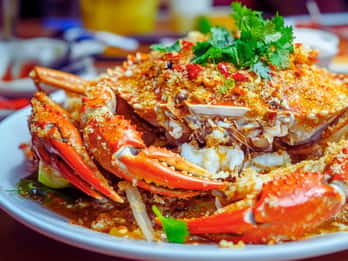
Crab pots by speedboat, then crab dinner
Speedboat, dinner included · 2 hours plus dinner
✓ Free cancellation
from €162
Book on GetYourGuide
Lofotpils brewery tour in Svolvær
Brewery tour, 18+ · 1 hour
✓ Free cancellation
from €49
Book on Viator
Food in Lofoten follows the calendar of the sea and the pastures. In late winter the skrei arrives, in spring the drying racks fill with cod, in summer the lambs graze the mountain slopes and in autumn the lamb, the berries and the first lutefisk of the season come to the table. Visit Lofoten's list of today's seafood reads like a catch report: cod, herring, halibut, salmon, crab, shrimp, sea urchin and oysters.
Skrei and the winter fishery
Skrei is cod that has reached spawning age. The Store norske leksikon describes the Lofotfisket, the seasonal fishery for this cod, as running from February to April, with the largest numbers arriving in the Vestfjord in February and March; Visit Lofoten gives the season as January to April. The fishery reaches back as far as written history and oral tradition go. In 1896 some 32,000 fishermen took part, and since the 1990s the number has been between 2,000 and 4,000.
A classic dish of the season is mølje, which Visit Lofoten describes as a mix of skrei meat, liver and roe. If you want to understand the fishery before you eat it, the SKREI centre near Kabelvåg, run by Museum Nord, explains it with an aquarium and the Lofoten Museum next door.
Stockfish from the racks
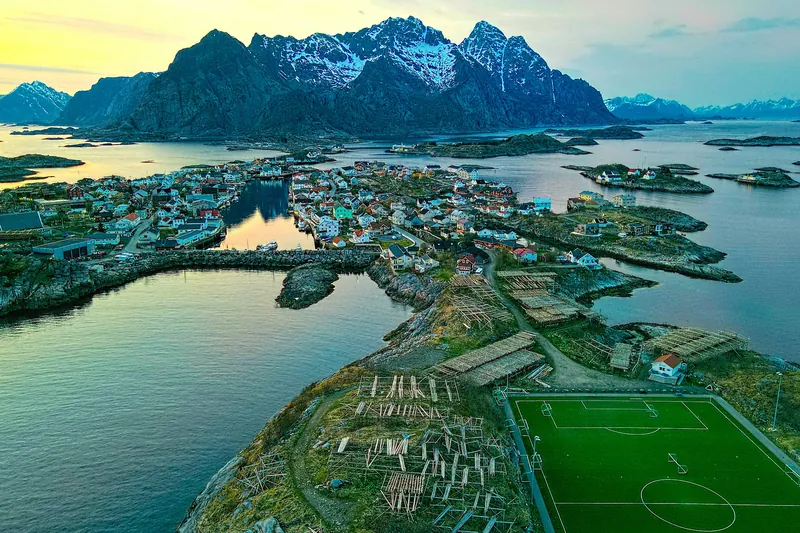
Tørrfisk, or stockfish, is mainly cod that is dried without salt. The fish hang on racks of birch poles, known as hjell, and take two to four months to dry, depending on the weather. Since 2007 a Norwegian regulation has protected the name Tørrfisk fra Lofoten as a geographical designation. In Italian the fish is called stoccafisso, and Visit Lofoten credits Querini, a seafarer shipwrecked off Røst, with making it famous in Italy. Røst is still a major exporter today.
At Å, at the end of the E10, the Lofoten Tørrfiskmuseum is devoted to stockfish, next to the Norwegian fishing village museum. Stockfish is also the base for lutefisk, which Visit Lofoten says is served with mashed peas, boiled potatoes and bacon. At least half of Norway's lutefisk is produced on Værøy, and the first of the season is available in October.
Lofoten lamb
Lofotlam is meat from lambs born, raised and grazed in Lofoten, and Visit Lofoten describes it as a protected geographical indication. The lambs are born in early May and sent to the mountains within their first two weeks, where they graze on herbs, grass and heather on the steep slopes. After five to six months they are slaughtered at the local abattoir in Leknes. Lofotlam can be on menus from August and through the autumn, traditionally as fårikål, lamb stewed with cabbage, or as pinnekjøtt.
Berries, sweets and beer
In autumn Visit Lofoten points to lingonberries on the ground and plenty of chanterelles and boletus in the woods. Lingonberries go into troll-cream, made of whipped egg, sugar and berries, and waffles with troll-cream are almost a national dessert on the islands. Cloudberries and blueberries grow here too, and local producers make ice cream, yoghurt, jam, cheese and beer.
The Lofotpils brewery in Svolvær shows its brewing hall on a guided tour that ends with a tasting of five beers. Norway's age limits apply: 18 for beer and wine, 20 for spirits.
Eating what you catch
Some fishing trips end with a meal. Off Kabelvåg you pull brown crab pots from a speedboat, and the chef at the restaurant on the dock cooks the catch. A shore fishing trip in Vågan cooks over an open fire, and serves a meal even if nothing bites; it needs your own car. On the fishing cruises from Svolvær you take the filleted fish home. Our fishing page compares the boats, and the Nusfjord and Å page covers the old fishing villages where the stockfish trade is still visible.
All tours side by side
Tours where food is the point or part of the deal: a five-course farm dinner, a crab dinner after pulling the pots, a brewery tasting in Svolvær, an open-fire meal by the shore and a fishing trip where you keep your catch.
| Tour | Format | Duration | Age | Rating | From |
|---|---|---|---|---|---|
| Four-hour fishing cruise from SvolværGo2LofotenThe crew shows you the gear for cod, pollock and haddock, helps gut and fillet your catch for you to take home and serves coffee and a non-alcoholic toddy on board. | Fishing boat, catch to take homeFishing gear, rain gear, life vest, coffee and biscuits | 4 hoursSjømannsgata 5, Svolvær | – | 4.7 (838 reviews) | From €124Free cancellationBook on GetYourGuide |
| Five-course farm dinner near StamsundAimees FarmA farm between Stamsund and Leknes serves a five-course dinner of local produce, including its Highland cattle, Mangalitsa pork and Lofotlam lamb, with a walk to see the animals. | Farm dinnerFive-course dinner, farm tour | 3 hoursValbergsveien 48, Vestvågøy | Ages 8+ | 5.0 (14 reviews) | From €158Free cancellationBook on GetYourGuide |
| Lofotpils brewery tour in SvolværLofotpilsA guided look at the brewing hall in Svolvær with the history of the brewery and a tasting of five beers at the end. | Brewery tour, 18+Guided tour, tasting of five beers | 1 hourOutside the big yellow gate, Lofotpils, Svolvær | Ages 18+ | 4.6 (9 reviews) | From €49Free cancellationBook on Viator |
| Crab pots by speedboat, then crab dinnerHooked on LofotenYou pull brown crab pots from a speedboat off Kabelvåg, and the chef at Restaurant Nyvågar cooks the catch with bread, sauce and salad. | Speedboat, dinner includedSpeedboat, flotation suit, crab dinner | 2 hours plus dinnerDock at Nyvågar Rorbuhotell, Kabelvåg | – | – | From €162Free cancellationBook on GetYourGuide |
| Shore fishing with an open-fire mealHooked on LofotenA guide takes up to six anglers to sea, river or lake spots in Vågan, provides licences and gear, and cooks the catch over an open fire, with a meal served even if nothing bites. | Shore fishing, own car neededFishing gear, licences, open-fire meal | 5 hoursSent 24 hours before, Vågan municipality (own car) | – | – | From €258Free cancellationBook on GetYourGuide |
Prices and ratings come from the booking platform and are shown in euros per person. If you book through these links we earn a commission. Your price stays the same. Sorted by number of reviews.
Questions travellers ask
What is skrei?
Skrei is the spawning cod that comes to Lofoten every winter. The Store norske leksikon dates the Lofoten fishery to February to April, with most fish arriving in February and March; Visit Lofoten speaks of January to April.
What is mølje?
A traditional skrei dish. Visit Lofoten describes it as a mix of skrei meat, liver and roe.
Is stockfish the same as clipfish?
No. Stockfish (tørrfisk) is cod that is dried without salt, hanging on wooden racks outdoors. Tørrfisk fra Lofoten is a protected geographical name in Norway.
When can I eat Lofoten lamb?
The lambs are born in early May and graze on the mountains through the summer. Visit Lofoten notes that Lofotlam can be on menus from August and is slaughtered throughout the autumn.
How old do I need to be to drink alcohol in Norway?
You must be 18 to buy beer and wine and 20 for spirits. The Lofotpils brewery tour in Svolvær is for guests aged 18 and over.
Where these facts come from
Dates, opening hours and rules change. We checked these pages in October 2026; the official source has the final word.
- Visit Lofoten: Food Culture in Lofoten
- Visit Lofoten: Lofotlam, lamb from Lofoten
- Visit Lofoten: Autumn in Lofoten offers fantastic food experiences
- Store norske leksikon: Lofotfisket
- Store norske leksikon: tørrfisk
- Store norske leksikon: Å
- Museum Nord: SKREI
- Lovdata: Alcohol Act (alkoholloven), age limits
- Tour pages on GetYourGuide and Viator, checked 23 October 2026